
Allie Rittman
Senior Product Manager

Baptiste Foy
Senior Software Engineer

Gabriel Somogyi
Senior Software Engineer

Igor Velichkovich
Staff Software Engineer

Jennifer Chen
Software Engineer

Ross Fenrick
Senior Product Designer
AI can now discover vulnerabilities and propose fixes at machine speed. Open source projects and vendors release more frequently, adding to your team’s workload. Yet rolling out patches and upgrades safely remains largely human-driven.
Each patch or upgrade involves the same chain of judgment calls: which breaking changes and deprecations apply, which applications and dependencies are affected, whether the update is safe for your configuration, how to roll it out across environments, and whether everything still works afterward. That work is necessary, repetitive, and high-skill, and it usually falls on a few experienced engineers.
These maintenance challenges are why we’re introducing Bits Maintenance, an AI teammate that takes on patching and upgrades, starting with the open source software your infrastructure runs on. It saves your team months of engineering effort and reduces security exposure. Now available in Preview, Bits Maintenance works 24/7 to detect when software needs to change, then analyzes the upgrade and generates a tailored plan for your environment. It executes that plan when authorized based on guardrails you define, verifies the change, rolls back or escalates on failure, and keeps an audit trail of every action. Bits asks for your input when human judgment or decisions are needed.
In this post, we’ll show how Bits Maintenance:
Automates infrastructure maintenance and upgrades, grounded in your environment
Works with your existing tools and learns how your team operates
Automated infrastructure maintenance, grounded in your environment
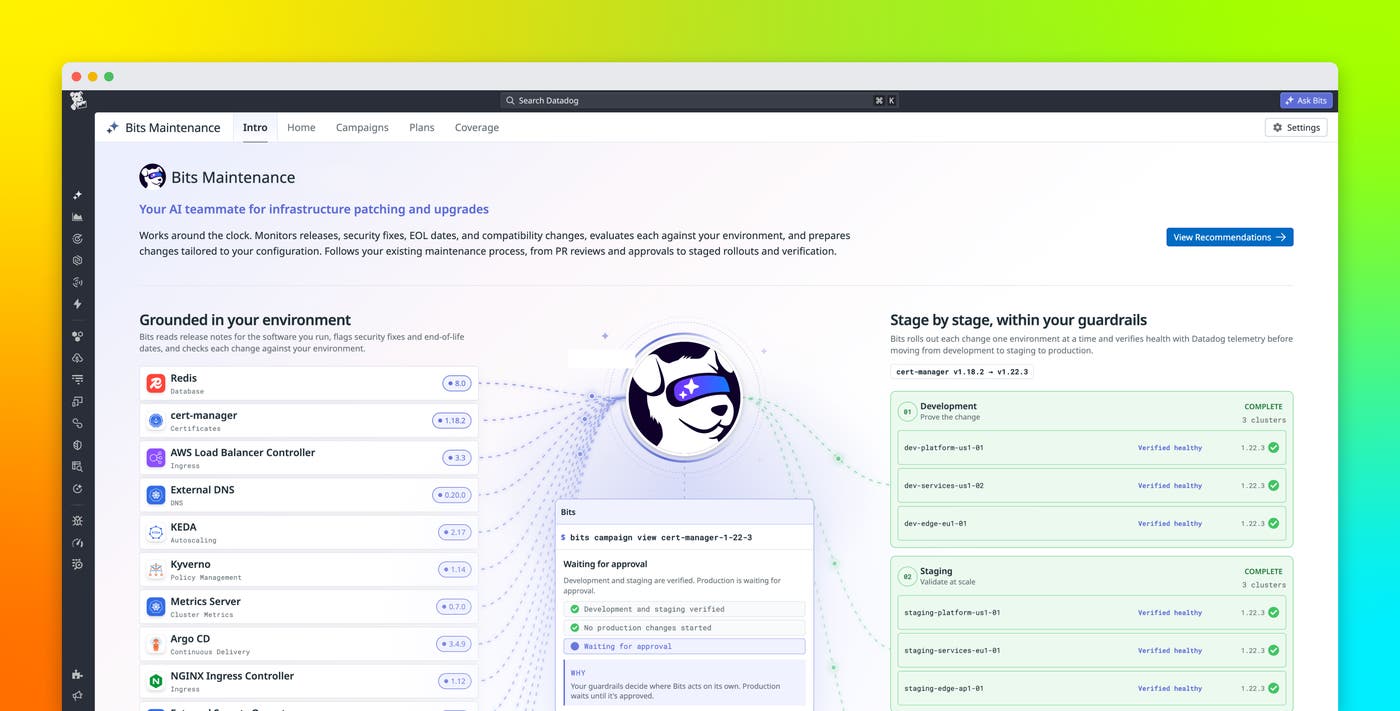
Bits tracks new releases, security fixes, end-of-life dates, and compatibility changes for the open source software running across your infrastructure. When an upgrade is needed, it explains why, recommends a version that is stable and compatible, and identifies affected installations.
A new release can contain dozens of changes, but not all are relevant to your environment. For example, a removed Helm chart value only requires a change if you use it, while a renamed metric can break dashboards or monitors that depend on it. Bits examines the changes between your current and target versions, checking each against your running environment to determine what truly requires updating.
It rules out what doesn’t apply, builds an upgrade plan around what does, and prepares the necessary code changes for review. When the evidence isn’t enough to reach a conclusion, Bits asks your team instead of guessing.
You’re always in control
You decide what Bits Maintenance can access, which changes it can make, and when your team needs to approve. Bits works within your existing permissions and deployment processes. Code changes go through pull requests, so your reviews and branch protections still apply.
You also choose how independently Bits operates. For example, development upgrades can run from end to end, while production waits for approval. For fleet-wide upgrades, you can start with one cluster, verify the result, and approve the next stage.
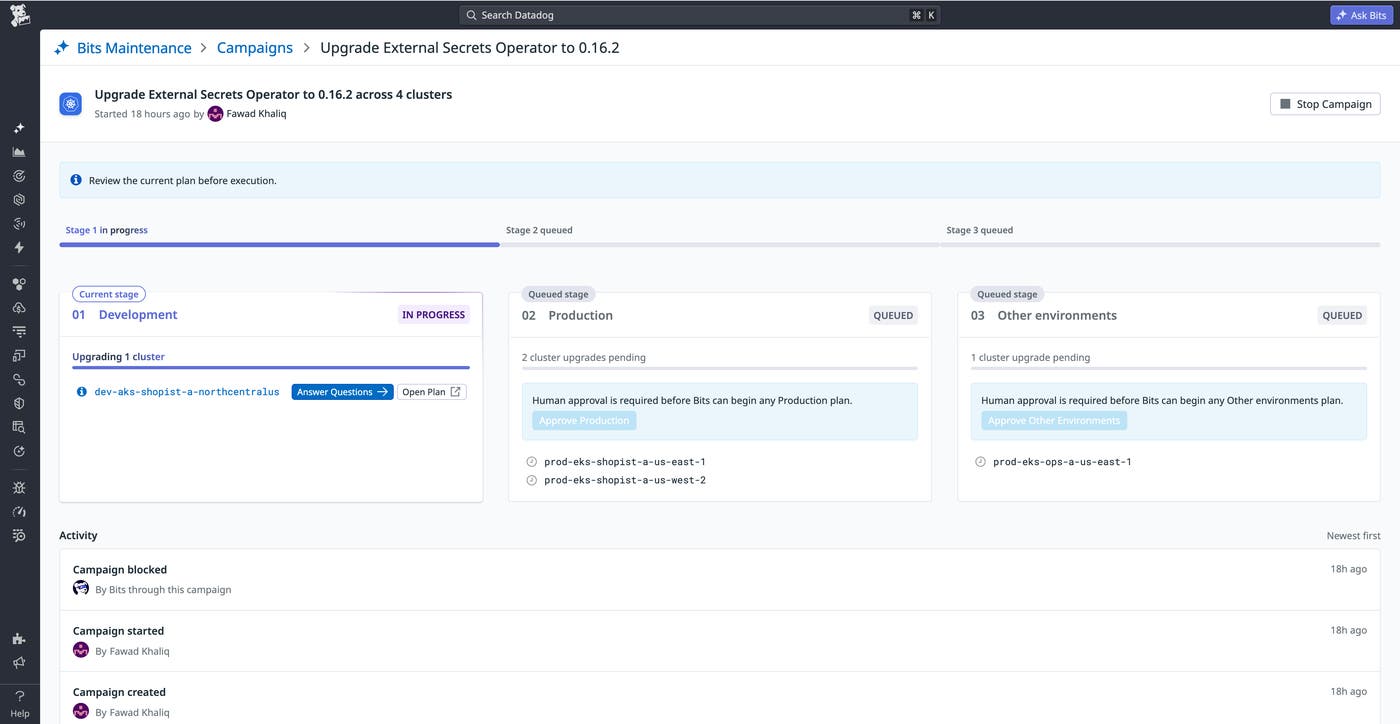
You can follow execution as it happens, inspect each step, and pause or cancel a rollout. Bits uses Datadog telemetry to compare system health before and after an upgrade, showing which checks passed, where something regressed, and what couldn’t be verified.
Works where you work, the way you work
Bits Maintenance works with the tools and processes your team already uses. It prepares pull requests in your repositories, preserves your customizations, and follows your existing review and deployment process. When a PR needs approval or a deployment is still running, Bits waits. Once the step is complete, it picks up where it left off.
You can also teach Bits how your team handles upgrades by adding steps to a plan, giving Bits custom instructions, or answering questions as they come up. Bits learns from that guidance and applies it to future upgrades, so your team doesn’t have to explain the same process every time.
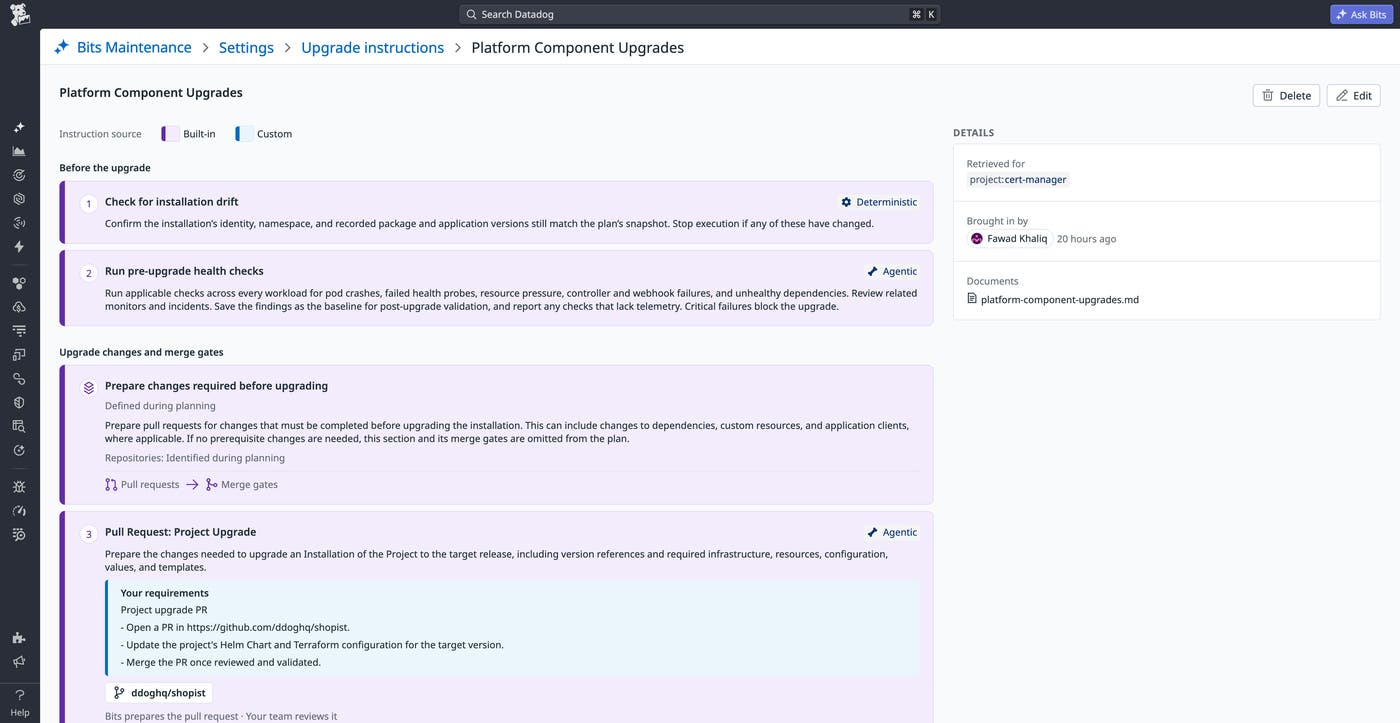
You can work with Bits Maintenance in Datadog, from the command line, through Slack, or with your own AI agents via the Datadog MCP Server.
Get started with Bits Maintenance
New CVEs, breaking changes, and end-of-life deadlines will keep coming. Bits Maintenance helps you keep up without spending weeks researching releases, preparing patches, and coordinating upgrades. You can address vulnerabilities sooner, keep your software up to date, and stay in control of production changes.
Sign up for the Bits Maintenance Preview; it’s free to get started.
If you don’t have a Datadog account, sign up for 14-day free trial.
