Jessica Yang
OpenTelemetry (OTel) has become the standard for collecting and routing telemetry across modern environments, giving engineering teams the flexibility to build portable, vendor-neutral pipelines. But adopting OTel at scale comes with operational challenges. Distributed teams own hundreds or thousands of collectors spread across clusters, environments, and deployments. Without a centralized view, collector fleets become susceptible to configuration drift and version sprawl, making it difficult to govern pipelines and maintain consistency. When telemetry is dropped or misrouted, engineers need to jump between repos and terminals to piece together root causes, increasing mean time to resolution.
Datadog Fleet Automation provides centralized visibility into all of your OpenTelemetry collectors, regardless of distribution or deployment model, so teams can quickly understand the status of their fleet and fix inconsistencies. It also provides deep insight into each collector’s live configuration, helping teams validate pipelines and troubleshoot misconfigurations faster.
In this post, we’ll show how you can use Fleet Automation to:
- Get a unified view of your entire OTel Collector fleet
- Easily inspect and troubleshoot OTel Collector configurations
Get a unified view of your OTel Collector fleet
Managing a distributed fleet of OTel collectors is challenging when each team maintains its own configurations, versions, and deployment types. Fleet Automation automatically surfaces your full collector inventory in a single place, including the Datadog Distribution of the OTel Collector (DDOT) and any upstream compatible distributions from open source ecosystems. This helps teams understand and standardize how collectors are deployed, reducing the need for manual audits across clusters and repositories.
Each collector entry in Fleet Automation includes rich metadata such as version, distribution type, and configured components. This context helps teams quickly understand fleet composition and identify inconsistencies. With Fleet Automation’s built-in search, filtering, and group-by capabilities, teams can:
- Spot outdated collector versions before rolling out new images or configurations.
- Compare usage across DDOT and open source collectors, and plan for migration paths.
- Identify collectors that use or are missing specific components so you can quickly standardize pipeline configurations.
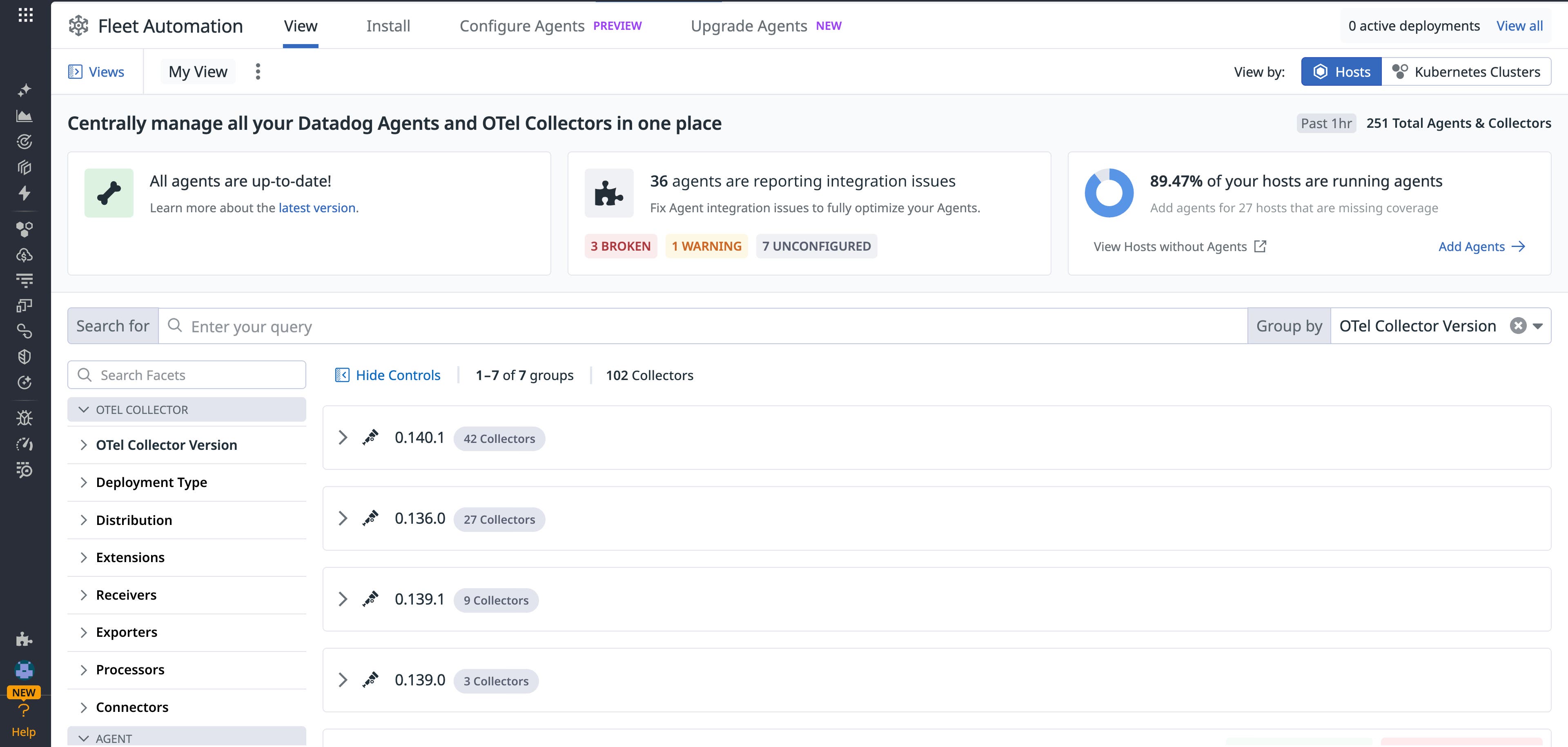
By giving you a consolidated inventory and metadata-rich view, Fleet Automation makes it easy to identify drift, standardize deployments, and reduce the operational overhead of managing collectors at scale.
Easily inspect and troubleshoot OTel Collector configurations
When telemetry pipelines break due to misconfigured components or faulty routing, the path to root cause is rarely clear. Fleet Automation brings each collector’s live configuration YAML directly into Datadog, removing the need to SSH into nodes or dig through Git repos to reconstruct what’s running in production.
Datadog automatically parses OTel Collector configurations and shows key components, including receivers, processors, and exporters, making it easier to understand how telemetry flows through your environment. Inline component highlighting helps teams navigate large or complex configurations and immediately spot misconfigurations or unsupported patterns.
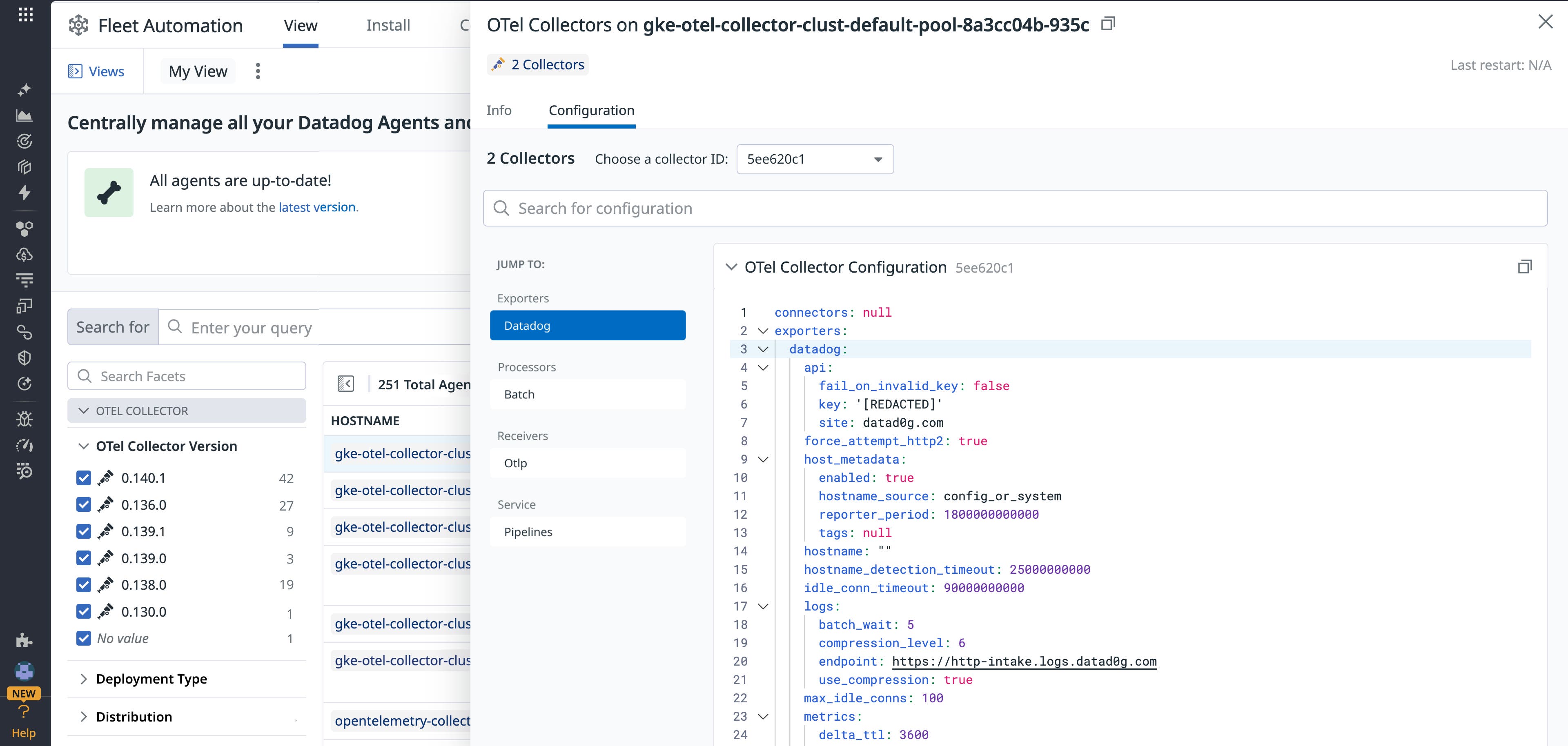
For teams using DDOT, Fleet Automation also provides one-click flare submission. Flares bundle logs and configuration context into a secure ticket submitted directly to Datadog Support. This removes back-and-forth troubleshooting and accelerates time to resolution when deeper diagnostics are required.
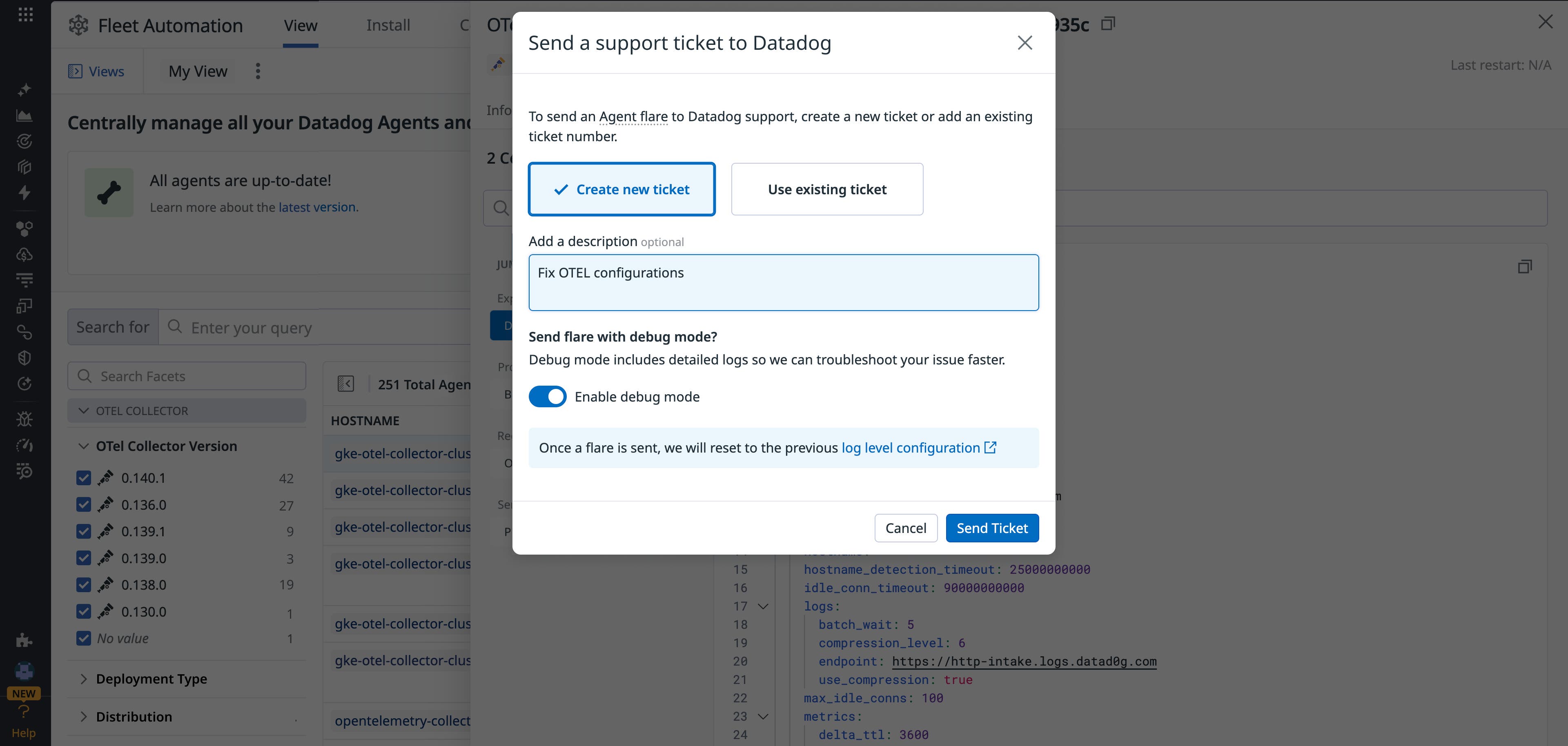
By centralizing live configurations and diagnostic workflows, Fleet Automation helps teams troubleshoot routing issues and validate pipelines, reducing collector management overhead and mean time to resolution.
Strengthening the foundation for simplified OTel pipeline control
As organizations expand their OpenTelemetry adoption, having fine-tuned control over collector configurations and deployments is essential for maintaining the health of critical telemetry pipelines and reducing the risk of breaking changes from rollouts. Centralized OTel Collector fleet visibility and troubleshooting further strengthens Datadog’s investment in simplifying control for OTel pipelines, so teams can confidently define, roll out, and govern OTel collectors at scale with Datadog.
Fleet Automation for OpenTelemetry Collectors is available for preview. To get started, fill out the preview intake form. To learn more about managing OTel collectors with Datadog, visit the documentation. If you’re new to Datadog, sign up for a 14-day free trial.