What is AI-led incident response?
AI-led incident response is an operating model in which AI becomes an active participant in detecting, investigating, coordinating, and learning from production incidents, rather than a passive dashboard engineers must interpret under pressure. It does not replace the incident channel teams already use; instead, it transforms what happens inside it, contributing context, surfacing hypotheses, and handling coordination overhead so engineers can focus on the judgment calls that require a human.
Why does incident response need to change?
AI is reshaping how software gets built, and that shift has a direct effect on reliability. In Google’s 2025 DORA report, 90% of respondents said they were using AI coding tools regularly, and more than 80% reported productivity gains as a result — but the same report warns that without strong engineering foundations, gains in throughput come at the cost of delivery stability, since pace of change is one of the most reliable predictors of incidents.
The systems absorbing this accelerated pace of change have also grown more complex: multicloud strategies are the dominant model, and nearly half of developers are deploying microservices, each with its own deployment cycle, dependency tree, and failure mode. When something goes wrong, the signal picture is fragmented, and every minute of confusion is expensive — unplanned IT downtime costs organizations an estimated $14,056 per minute, rising to $23,750 for large enterprises, and the typical outage caused by configuration issues now lasts more than a day.
How has incident response evolved?
Incident response tooling has evolved through distinct phases:
The paging-first model. For most of software history, intelligence lived in people: an alert fired, an engineer paged through the roster until the right owner picked up, and debugging relied on institutional knowledge that was not written down anywhere. This model held while systems were small enough to reason about, but broke down as architectures grew distributed and the blast radius of failure expanded.
The chat-first model. Bringing incident coordination into a shared messaging platform, such as Slack, was a genuine leap forward and remains the operational standard. Engineers join from wherever they are, dashboards get linked, and decisions get made in the open. But this model left the hardest part untouched: the cognitive work of diagnosis under pressure. Despite a decade of tooling investment, most organizations still take more than two hours to resolve incidents, and in a typical bridge only a few people are actively debugging at any given moment while the rest write status updates or wait for context.
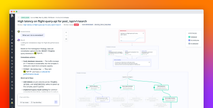
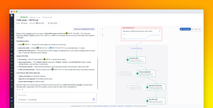
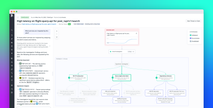
The AI-first model. The next evolution transforms what happens inside the incident channel rather than replacing it. From the first signal, AI investigation can begin before a human is even paged: related alerts are grouped into a single page, relevant logs and recent deploys are pulled automatically, and a root cause hypothesis is surfaced in plain language. That context follows engineers across surfaces — Slack, mobile, video bridge — so no one has to re-explain what has already been tried, and when the incident closes, AI-generated postmortems and suggested action items keep the learning loop from depending on individual memory.
What does AI-first incident response look like in practice?
AI-first incident response is typically organized into three phases:
- Detect and triage. Related alerts are grouped, deduplicated, and correlated before a human is paged, and AI investigation begins automatically, querying telemetry, recent deployments, and upstream and downstream services to surface a root cause hypothesis in plain language.
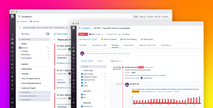
- Coordinate and resolve. Declaring an incident automatically spins up coordination — a dedicated chat channel and video bridge with the right people added. AI remains an active participant throughout, answering observability questions in plain language, generating continuously updated summaries, and posting key decisions back to the incident channel.
- Learn and improve. Postmortems are generated from the live timeline rather than reconstructed from memory, AI can suggest follow-up action items based on investigation context, and structured incident data feeds back into future investigations so every resolved incident makes the next one faster to detect and diagnose.
None of this works without a foundation of full-stack observability: AI-first incident response without complete telemetry coverage is inference on incomplete data, since the accuracy of any hypothesis — human or machine — is bounded by the quality and coverage of the signal feeding it.
What is the maturity path to AI-native incident response?
Organizations typically progress through five stages:
- Fragmented. Monitoring tools have been added service by service, with a mix of vendors and partially configured integrations. When an incident fires, engineers spend the first 20 minutes figuring out where to look rather than what is wrong.
- Instrumented. Metrics, logs, traces, and security signals are consolidated into a single platform, correlated and consistently tagged. Teams stop debating which tool to believe and start debugging — though a well-instrumented system with no AI augmentation can still produce a multi-hour incident, since the cognitive load of diagnosis still falls entirely on whoever is on call.
- Augmented. AI contributes to active incidents: alerts are deduplicated and grouped, root cause hypotheses surface automatically, and postmortem drafts compile from the live timeline. The risk at this stage is skipping the repetition needed to calibrate trust in AI, leading teams to either over-rely on it or dismiss it after one bad call.
- Autonomous. For known failure classes, AI handles the full workflow — summarizing the incident, notifying stakeholders, executing remediation, and keeping the status page current — while engineers are pulled in for oversight and novel situations. This stage requires defined approval gates for high-impact actions and regular review of automated decisions.
- Proactive. The end state is not simply faster resolution but fewer incidents: AI monitors against learned baselines, catching degradations before they breach SLAs or reach users, and the on-call engineer is paged only for genuinely novel situations. Reaching this stage requires the compounding work of the earlier stages — teams cannot detect a degradation proactively if the service is not instrumented, and cannot automate a remediation they have not validated manually first.
Conclusion
Software systems are growing more complex, and AI-assisted development is accelerating the pace of change in production, resulting in more deployments but also more risk and more incidents. A unified telemetry layer feeding a single AI system that investigates incidents, detects anomalies, generates hypotheses, and learns from every resolution is what makes AI-powered incident response trustworthy rather than just fast.